The Sunday Times Clue
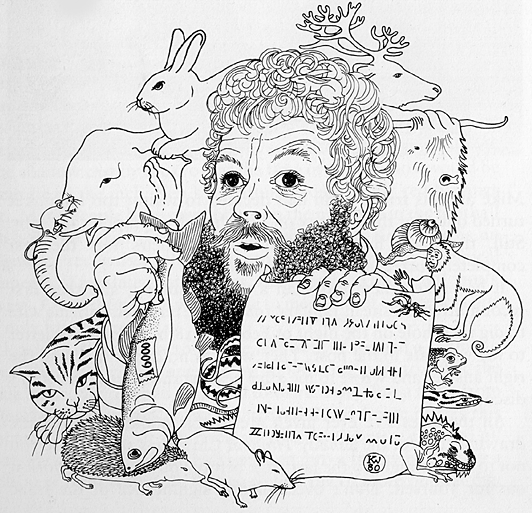
This illustration, which first appeared in the Sunday Times on December 21, 1980, was reproduced in the paperback edition of Masquerade, but its solution was not included. It has been mentioned, however, that Mike Barker and John Rousseau–the men who solved the riddle but did not win as their solution was received too late–also solved this clue and it was a confirmer for them. It stumped me until two friendly folk (Mark Parry and Steven Berry) sent me the method for finding the clue’s message and the message itself.
Keeping in mind that this clue originally appeared on newsprint helps greatly. It’s easily folded and light passes through it. That being the case, the pieces of letters do come together to form fully readable English (well, mostly) if the lower half of the paper is folded in the center (below the third line of symbols) and the entire message is read in a mirror. You can try this yourself if you print out the above drawing, but through the magic of Adobe Photoshop, we can flip ‘n fold the image digitally and reveal the following phrase:
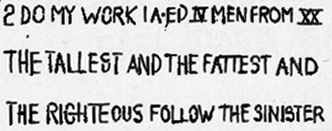
“To do my work, I appointed four men from twenty, the tallest and the fattest, and the righteous follow the sinister.”
Most of this makes sense once you know the solution, but boy, what a tough clue. Both Mark and Steven pointed out that “I A.ED” translates as “I appointed,” which stumped me for a while. I still feel that this hints in a small way toward the “eyes that point toward the prize” concept, as Kit reveals at the end of the paperback, but the phrase largely offers insight as to how the master phrase was created (and how it can be determined by the reader). “Four men from twenty” means four fingers/toes out of the twenty digits on the human body. “The tallest and the fattest” refers to the size of the digits on the hands and feet–use the two longest fingers and the two largest toes. “The righteous follow the sinister” helps you determine the order the letter order/decoding, using the left (sinister) eyes through left fingers & toes first, then the right(eous) ones. The idea of merry men as fingers comes from an old nursery rhyme; for the sake of completion, does anyone know it in full?
Steven Berry and Hyungrok Kim offer a scientific analysis of the fish: The symbol next to the “6000” written on the fish is an ångström, the measurement of light wavelength. 6000 ångströms = 600 nanometres, which corresponds to a reddish orange. “Why am I not surprised to find a red herring on the drawing?” says Steven, while Hyungrok adds “Reddish orange is a more realistic colour for the flesh of certain smoked fish from which the phrase ‘red herring’ derives.”
Chris Cole mentioned that this clue and its solution are described in Bamber Gascoigne’s book Quest for the Golden Hare. It contains a detailed breakdown of this clue, and it provided me with the final unknown element: the importance of the animals surrounding Kit. In sequence, they are a Mouse, Elephant, Rabbit, Reindeer, Yak, Cat, Hedgehog, Rat, Iguana, Snake, Toad, Monkey, Ant, and Snail. The beginning letters of each animal spell out a simple and appropriate message, as it was orignally published on December 21, 1980: MERRY CHRISTMAS. The hare in Kit’s hair is no doubt there just as a visual pun and to keep the “find the hare in every picture” pretense going.








{ 9 comments… read them below or add one }
I am so glad to have stumbled on this site. Like many people from this generation I fell in love with Kit Williams’ works via this book but unfortunately most of the more elaborate clues evaded me.
Even though the hare has been found, I still think it is fun just to have an excuse to look at these lovely paintings again and be inspired.
I echo Bella’s comments having just found this site (after reading the story in the Daily Mail regarding the Golden Hare being put on display. A reminder of youth (for those children of the 70s) and the spirit of imagination.
I find it amazing that this extraordinary work is still inspiring people after more than 30 years! A form of success which should warm Kit Williams’ heart without making him feel hassled. Thank you for the wonderful journey – enjoyed again recently in a personal project ‘The Hare’ on an art course. First discovered in 1979. Still going strong, I see!
I am so glad I found this site, I remember as a younger person the fasinating story and remembering the frustration of not being able to drive my fathers car and witing at christmas for a copy of the book, which never came, this has been a lovely walk down memory lane for me , and for that I thank you. Thank you Kit for making my childhood a happy and adventurous one , the rabbit Jack is so beautiful as is the book . Take care
I remember the magic of Kit’s book and spending hours trying to decode the mystery… i was 11.
With the hare hiding under the skirts of Penny Pocket and a chance quote on the Reader’s Digest atlas led me to link this to the legend of Saint Melangell of Wales who would hide hunted hares under her long skirts.
My family and i actually visited that place in Wales… a church called Pennant Melangell:
http://en.wikipedia.org/wiki/St_Melangell%27s_Church,_Pennant_Melangell
How wonderful that the magic of Kit’s work could lead an 11 year old boy into the legends past
Julian Haynes
Returned yesterday from having made the trip to the V&A where the golden hare is currently on display. I now feel I have finally found it some 32 years after having dug late at night sometime in 1980 under an oak tree in the village of Bardwell to no avail.
I had convinced myself that the answer lay within the front cover picture. I chanced upon a picture of Bardwell which seemed to fit and there within the small church (accessed by obtaining a key from The LIMES – another anagram of SMILE written in red letters around one of the pictures) was a memorial to a boy who died at the time of the war of the roses and who shared a birthdate with Kit Williams!
I still have Kit’s letter informing me in mirror writing that the answer “lies elsewhere” . Happy days.
Thank you for this wonderful site. I think that this might be the ‘merry men’ rhyme to which you refer:
Dance, thumbkin, dance!
(Close right hand,
point thumb upward,
hand still remain in position)
Dance, thumbkin, dance!
Thumbkin cannot dance alone,
So dance, my merry men, ev’ry one,
(Hold up left hand fingers in motion)
And dance, thumbkin, dance!
(Thumb joins in movement)
Dance, foreman, dance!
(Close right hand,
point pointer finger upward,
hand still remain in position)
Dance, foreman, dance!
Foreman cannot dance alone,
So dance, my merry men, ev’ry one,
(Hold up left hand fingers in motion)
And dance, foreman, dance!
(Pointer finger joins in movement)
Dance, middleman, dance!
(Close right hand,
point middle finger upward,
hand still remain in position)
Dance, middleman, dance!
Middleman cannot dance alone,
So dance, my merry men, ev’ry one,
(Hold up left hand fingers in motion)
And dance, middleman, dance!
(Middle finger joins in movement)
Dance, ringman, dance!
(Close right hand,
point ring finger upward,
hand still remain in position)
Dance, ringman, dance!
Ringman cannot dance alone,
So dance, my merry men, ev’ry one,
(Hold up left hand fingers in motion)
And dance, ringman, dance!
(Ring finger joins in movement)
Dance, littleman, dance!
(Close right hand,
point pinkie upward,
hand still remain in position)
Dance, littleman, dance!
Littleman cannot dance alone,
So dance, my merry men, ev’ry one,
(Hold up left hand fingers in motion)
And dance, littleman, dance!
(Littleman joins in movement)
Hi (wonderful page). When I read the clue the first thing to came into my mind were the hands of a clock pointing 4:20. ‘The use of roman numerals supports my guess’, I thought. Silly me.
I’m pleased I finally found the answers to the masquerade book. My mum bought me this book 1979 I could not fathom it out . Thank you for the solution